
Federal AI’s next test: Governing mission action, not just data
Federal agencies have spent years building the discipline to manage data and evaluate AI pilots. The focus now is governing how AI shapes mission work, from recommendations and case routing to approvals, investigations, eligibility decisions, and policy enforcement. When AI influences these decisions and actions, agencies remain accountable for the effects on people, public dollars, and mission outcomes.
Many agencies have invested in the building blocks: trusted data, analytics, workflow tools, and AI capabilities. The gap is operational: connecting those investments to mission processes so that AI-informed actions are consistent, explainable, auditable, and aligned to mission risk. As AI moves from experimentation into mission operations, agencies must demonstrate how it improves results while preserving accountability.
We describe this as governed mission action. It pairs AI with defined rules, process guardrails, and proportionate human oversight so that AI-supported recommendations and actions can be traced to the underlying data, evidence, controls, and human decisions. Because those capabilities often span multiple platforms, governed mission action also requires bringing the right technology ecosystem together around the mission rather than expecting any one platform to do everything.
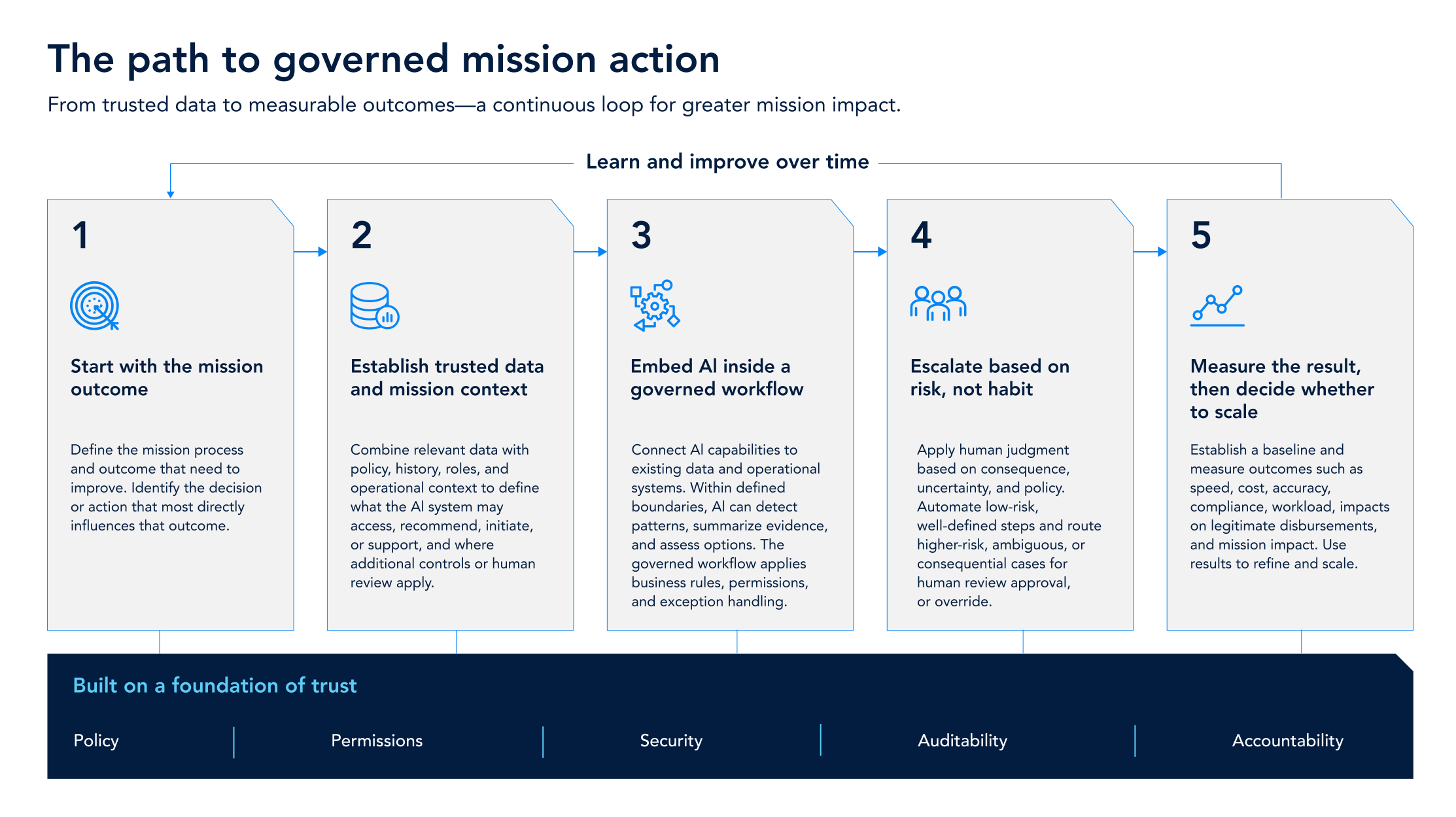
5 principles for governed mission action
1. Start with the mission outcome
Before choosing a platform, model, or AI capability, agency leaders should define the mission process and outcome that need to improve. From there, they can identify the decision or action that most directly influences the outcome.
Consider a benefits program that seeks to reduce improper payments without slowing legitimate disbursements. The mission outcome isn’t simply “deploy AI” but instead to identify higher-risk transactions earlier while allowing valid payments to move efficiently.
2. Establish trusted data and mission context
With the mission outcome in mind, agency leaders can identify where the relevant data already lives. That data should then be combined with policy, history, roles, and operational context to define what an AI system may access, recommend, initiate, or support, as well as where additional controls or human review apply.
Relevant context for our example benefits program might include payment history, eligibility rules, prior audit findings, case notes, policy exceptions, and other authorized data. The policy and case context helps the workflow assess whether an unusual pattern warrants additional review rather than treating every anomaly as evidence of an improper payment.
3. Embed AI inside a governed workflow
A governed workflow can connect AI capabilities to an agency’s existing data and operational systems without requiring a wholesale replacement of current technology. Within defined boundaries, AI can detect patterns, summarize evidence, and assess options.
In our example situation, if AI identifies an anomaly in payment data, it can assemble supporting evidence and recommend a next step, such as routing the transaction for secondary review. The governed workflow can then apply the appropriate business rules and permissions, route the case to an authorized analyst, and allow the payment to proceed, remain on hold, or be escalated based on the reviewer’s determination.
4. Escalate based on risk, not habit
Governed mission action defines where human judgment belongs based on consequence, uncertainty, and policy. Low-risk and well-defined steps may call for greater automation. Higher-risk, ambiguous, or consequential actions should trigger human review, approval, or override. This makes human oversight intentional rather than universal while preserving accountability.
If the anomaly meets predefined risk criteria or confidence thresholds, the workflow can route the transaction, supporting evidence, and recommended action to an authorized reviewer. The reviewer can then examine the evidence and applicable policy and determine whether to clear the transaction, request additional information, or escalate it for further investigation.
5. Measure the result, then decide whether to scale
Before implementation begins, leaders should establish the baseline against which success will be measured. Measures might include speed, cost, accuracy, compliance, workload, or service quality. Comparing operational results with those initial measures provides stronger evidence for scaling than simply counting AI activity, users, prompts, or pilots.
The benefits program could consider outcomes-based measures such as prevented improper payments, review cycle time, false-positive rates, analyst workload, impacts on legitimate disbursements, and compliance outcomes.
How the modern technology ecosystem supports governed mission action
No single platform needs to perform every part of this mission loop. In most federal environments, trusted data, AI capabilities, operational workflows, and mission systems already span multiple technologies. Through governed mission action, agencies can orchestrate those investments around the mission outcome.
The Appian and Snowflake technology alliance provides one example of how this pattern can work in practice. Snowflake can support governed enterprise data, analytics, and AI capabilities. Appian can bring that intelligence into processes, cases, business rules, human decisions, and auditable workflows. Appian’s support for Model Context Protocol (MCP) can extend that pattern by allowing AI agents and external capabilities to interact across platform boundaries under defined controls. While Appian and Snowflake provide one example, the governed mission action model can be applied across a range of data, AI, workflow, and case management platforms.
ICF works closely with both Appian and Snowflake through our technology ecosystem relationships, giving our teams a practical view into how these capabilities can be combined around real mission needs.
ICF’s role is to bring those relationships and capabilities together around the mission. That means translating policy, operational needs, data, decision rights, and human accountability into an architecture that uses the right capability for each part of the problem rather than forcing the mission into a predefined technology stack.
From trusted data to governed action
Without governed action, agencies risk building AI that generates more insight without improving the work or, worse, accelerates inconsistent or opaque decisions. The goal is not to automate everything, but to connect trusted intelligence to the right action, with the right controls, and prove the value before scaling.
Agencies have spent years strengthening how they govern data. The next imperative is to apply that same discipline to how AI-supported recommendations become decisions and how those decisions translate into mission action. This is how agencies move AI from promising pilots to trusted, scalable operational capabilities.
Learn more about how ICF brings together leading technology partners to solve complex mission challenges through our Technology Ecosystem Alliances.