
Making data AI-ready: How federal agencies must rethink integration
What fragmented data architectures mean for AI—and how to fix them
Federal agencies are under pressure to deliver services that are faster, smarter, and more secure. But when data is trapped in disconnected systems, agencies struggle to act on insights, coordinate across programs, and meet their missions at speed. Core government functions—from fraud prevention and public health surveillance to transportation efficiency and national security—depend on data that can be shared, trusted, and used across the enterprise. Without modern integration, agencies can’t fully capitalize on the promise of AI—or the value already embedded in their data.
But more than 80% of federal leaders say their data is not AI-ready, according to our latest research. Thirty-five percent of those leaders cite poor data quality as the top barrier to scaling AI within their agencies.
This is a serious problem that agencies can’t afford to keep kicking down the road. Integration across systems, siloes, and agencies is no longer a plumbing exercise; it’s the linchpin for making data AI-ready, today and into the future.
3 obstacles agencies face when integrating data
Technology has transformed the data landscape in just the past few years. Agencies now ingest information from satellites, sensors, citizen apps, cloud systems, legacy databases, partner organizations, and much more. Three of the biggest challenges agencies face when integrating data today are:
Growing complexity of data
Agencies are ingesting data in more formats than ever before. Ten years ago, most federal data was structured in spreadsheets, databases, and reports. Today, data comes from structured systems, but also from semi-structured (e.g. JSON logs, medical devices, and IoT sensors) and unstructured (e.g., images, video, audio, PDFs, and satellite feeds) sources.
A single mission workflow today may rely on all three of these data formats. Take disaster response as an example. This work integrates geospatial imagery, field sensor data, social media signals, and structured logistics data. This complexity makes integration significantly more demanding.
Shifting from batch to real-time data
Years ago, agencies refreshed their data daily or hourly. Now, missions require near-real-time or streaming integration. Use cases such as fraud detection, vulnerability management, public health outbreaks, transportation or supply chain monitoring, and defense sensor networks demand immediate responses, and the integration layer must keep up.
Returning to the disaster response example: The geospatial imagery from an airplane flying over a devastated area can send images back to a central location, allowing the data to be dissected in near real-time.
AI magnifying the stakes
In our previous article on data governance, we referenced the 1-10-100 rule of data quality, pioneered by George Labovitz and Yu Sang Chang: it costs one dollar to prevent a data error, ten dollars to correct it, and one hundred dollars if the error is ignored. In the age of AI, that curve steepens dramatically—closer to 1-10-100-1,000,000.
Consider an AI agent that processes benefit applications or compliance forms using data pulled from multiple systems. If those systems aren’t properly integrated, a single mapping or timing error can be amplified at machine speed—misclassifying thousands of submissions before anyone notices. Correcting the mistake isn’t just a technical fix; it can require reprocessing cases, issuing corrections, restoring public trust, and explaining errors to oversight bodies.
In our earlier discussion, we framed this challenge around governance. But the same dynamic applies to integration. When integration breaks in an AI-enabled environment, errors don’t stay small—and the costs escalate just as quickly.
How agencies can master modern-day data integration
Federal agencies must adapt their approaches to integration to operate in this transformed data environment. They can do so using these tools and protocols that make integration less expensive and cumbersome.
Zero-ETL and low-code integration approaches
For years, federal agencies have relied on ETL (extract, transform, and load) pipelines to integrate data from multiple systems into centralized warehouses. That approach worked when data moved in predictable batches. But today’s environments—streaming data, operational systems, and AI-driven use cases—demand faster access, lower latency, and far less custom code to maintain.
Zero-ETL approaches address these challenges by reducing dependence on brittle, batch-style pipelines. Rather than copying data into yet another environment, cloud-native sharing, streaming, and federation make data available across systems in near-real time, with fewer points of failure. The result is less duplication, faster integration of new data sources, and a more scalable foundation for secure, AI-enabled decision-making.
Declarative and automated data pipelines
Building upon Zero-ETL, the industry is moving towards declarative and automated integration approaches. Instead of hand-coding integration logic, these next-generation platforms allow engineers to define what the pipeline should achieve while automation handles the execution. This reduces development effort, improves consistency, and enables rapid scaling across data domains.
AI-enhanced integration
AI accelerates multiple aspects of data engineering, including automatic schema detection, automated metadata tagging and enrichment, anomaly detection, and quality scoring. AI turns the integration layer into an intelligent orchestration engine, one that can adapt, validate, and optimize data flows rather than simply move data between systems.
Cloud-native orchestration and autoscaling
Modern platforms dynamically scale resources based on workload, reducing cost while enabling high throughput for streaming, batch, and hybrid pipelines.
Pipeline and data source protection
Modern integration pipelines must protect data as it moves across systems. This includes encrypting and decrypting data at run time based on classification levels, isolating workloads across trust boundaries, applying validation checks before and after transformations, and redacting or masking sensitive information when required. Pipelines must also support secure, cross-agency data sharing with strict permission controls to maintain accountability and compliance.
Modern data integration in action
These modern approaches to integration are already transforming mission delivery across the federal landscape:
- The United States Forest Service (USFS) integrated structured telemetry, satellite imagery, and streaming environmental signals to deliver real-time wildfire intelligence using serverless architecture. Near-real time incident updates now reach fire commanders in minutes instead of hours, strengthening USFS’ predictive modeling and response.
- The Federal Emergency Management Agency (FEMA) used configuration-as-code patterns and managed connectors to develop a cloud-native enterprise integration for data mesh. This replaced custom ETL and securely exposed multiple cloud and on-prem systems to data users, improving performance and scalability across FEMA’s analytics environment.
- A large federal public health agency developed a governed pipeline to integrate the unstructured data that powers generative AI for one of its websites. This pipeline ingests and enriches podcasts, policy documents, and federal health content, enabling the website’s retrieval-augmented generation (RAG)-based agent to deliver accurate, source-cited responses rooted in authoritative federal data.
Architecting AI readiness
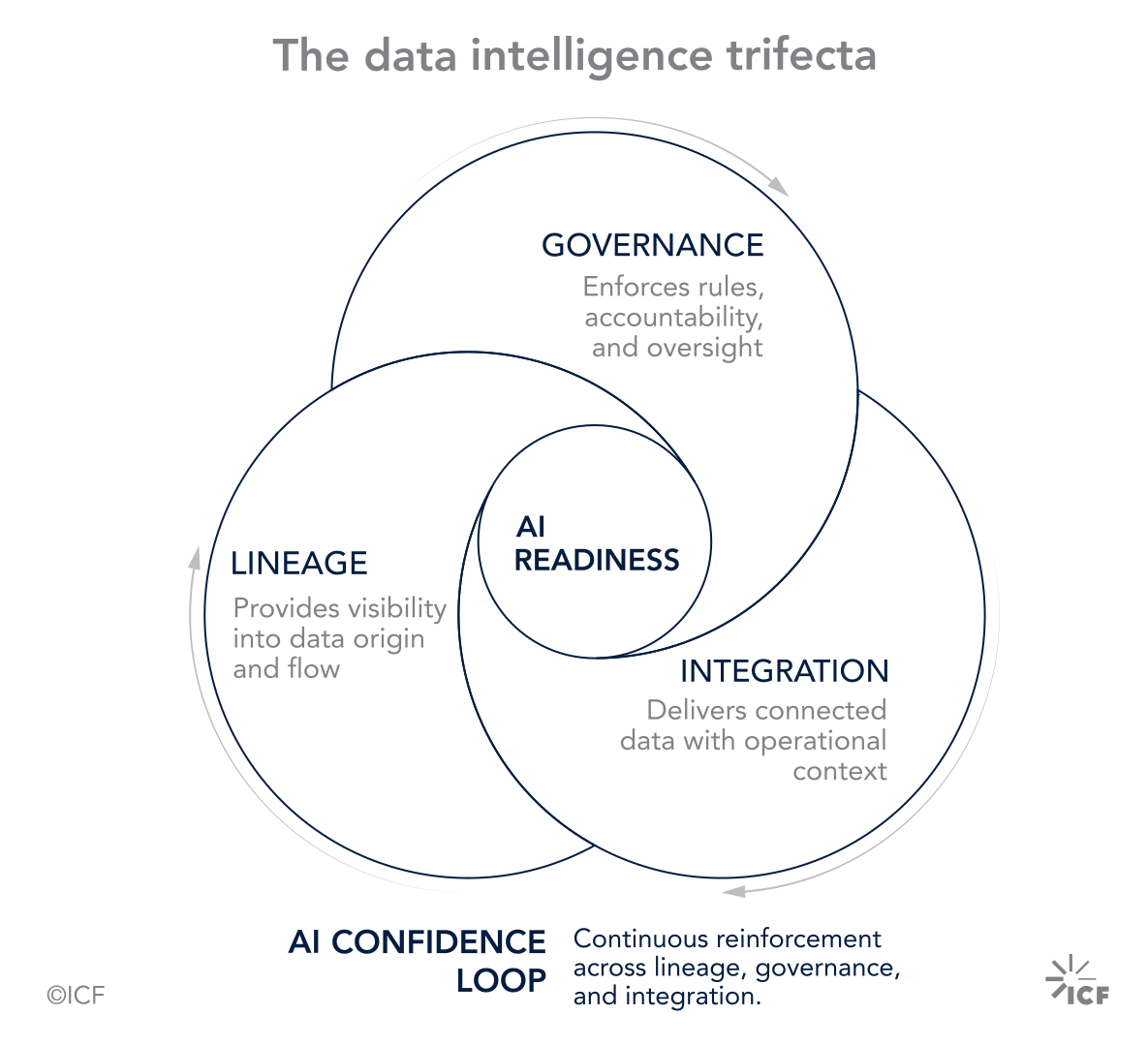
AI readiness is not achieved through a single capability. It is built through the coordinated execution of lineage, governance, and integration.
- Lineage ensures visibility and trust.
- Governance ensures control and accountability.
- Integration ensures connectedness and context.
Together, these three disciplines form the data intelligence trifecta. They create a continuous AI confidence loop—where data is verified, governed, and connected at every stage of its lifecycle. The result is a strategic asset that is trusted, explainable, and ready for enterprise AI deployment.
ICF Fathom, our suite of AI solutions and services, empowers agencies to operationalize this AI confidence loop. Fathom integrates platform capabilities, mission-aligned solutions, and expert services into a unified ecosystem that supports data engineering, DataOps, MLOps, and AI modernization at enterprise scale.