
Improving C&I program participation with behavioral insights
Learn how a behavioral quadrant framework can align outreach with customer mindsets to help utilities increase program participation.
With U.S. electricity demand projected to grow 25% by 2030, utilities face mounting pressure to increase participation across commercial and industrial (C&I) energy efficiency and demand response programs. Utilities have invested heavily in customer data, targeting tools, and digital engagement platforms, but participation outcomes remain uneven—even among C&I customers who are eligible, cost-effective, and well aligned with program goals.
The challenge is not access to data or program design. It is how businesses make decisions.
How C&I customers evaluate programs
C&I customers do not evaluate energy programs based solely on their business’s characteristics. Participation decisions are shaped by unique organizational realities: budget approval cycles, competing capital priorities, stakeholder alignment, operational risk tolerance, and time constraints. These internal dynamics determine whether a business moves from awareness to action—and whether that participation is sustained over time.
At the heart of these decisions are two perceptions: the benefits a decision-maker expects to gain and the barriers they believe the business must overcome. These perceptions often matter more than the objective value of a program.
For example, a manufacturing facility, a retail chain, and a hospital may all face rising energy costs and qualify for the same program. Yet each perceives value of the program through a very different operational and decision-making lens, leading to very different responses to identical outreach.
Why traditional segmentation is not enough
Industry and account-based segmentation remain essential components of C&I program strategy. They help utilities understand operational differences, equipment profiles, and energy use patterns, which are all essential for forecasting savings and allocating program resources. However, they do not fully explain why customers engage—or fail to engage—with energy programs.
Two customers that look nearly identical on paper may perceive participation very differently. One may see clear value and low effort, while the other sees uncertainty, risk, or organizational friction. Traditional segmentation identifies who customers are; it does not explain how they make decisions.
A behavioral lens for C&I engagement
To help utilities align outreach with the behavioral realities of customer decision-making, ICF developed a C&I behavioral quadrant framework that complements traditional and account-based segmentation.
Rather than replacing existing segmentation approaches, the framework adds a behavioral lens that focuses on customer perceptions—making engagement more relevant, timely, and effective.
The framework organizes customers along two behavioral dimensions that shape how participation decisions are evaluated:
- Benefits of participation: Ranging from low to high on the horizontal axis, perceived benefits reflect what customers believe they will gain. These may include financial savings, operational improvements, sustainability progress, resilience, or reputational value. Importantly, perceived benefits may differ from actual incentives or savings.
- Barriers to participation: Ranging from low to high on the vertical axis, perceived barriers include practical constraints such as time, budget, and organizational complexity, as well as psychological factors such as uncertainty, risk aversion, and perceived complexity.
Together, these dimensions create a simple but powerful way to anticipate customer behavior and tailor engagement accordingly.
The four behavioral quadrants
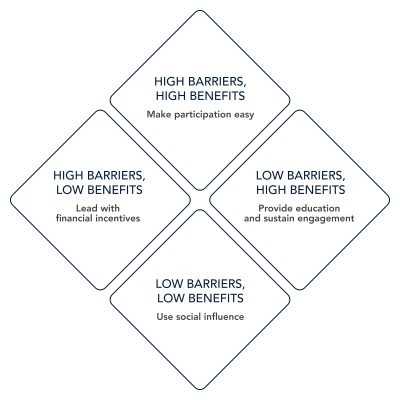
Mapping customers across perceived benefits and perceived barriers produces four distinct quadrants. Each represents a different customer mindset and requires a different engagement strategy to move customers forward and increase the likelihood of enrollment and long-term participation.
Each quadrant is dynamic. Customers can move across quadrants over time as their awareness, experience, and organizational context change. The goal is to move customers toward Low Barriers, High Benefits, where they’re ready to participate and see clear value. However, most customers start elsewhere, which is why understanding their current mindset determines the right engagement strategy.
The table below shows how to identify which quadrant a customer falls into and what engagement strategies work best for each:
| Quadrant | Customer mindset | Key indicators | Primary strategy | Tactics & channels |
| High Barriers, Low Benefits | Risk-averse; overwhelmed; uncertain about ROI | Below-average email engagement; minimal program interaction; limited account data | Lead with incentives to shift benefit perception | Instant discounts; upfront rebates; ROI calculators; financial case studies via direct mail and account managers |
| High Barriers, High Benefits | Motivated but facing obstacles (complex structures, resource constraints, multiple stakeholders | High email engagement without conversion; complex organizational structure | Remove friction | On-site assessments, decision tools; personalized follow-ups; dedicated support via account managers and technical webinars |
| Low Barriers, Low Benefits | Able to participate but don’t see compelling reason; “What’s in it for me?” | Average to below-average engagement; simple structure; known contact | Use social influence to increase perceived value | Peer testimonials; ambassador programs; social proof messaging via email, webinars, and trade associations |
| Low Barriers, High Benefits | Ready and motivated; few obstacles | Strong engagement paired with action; high email opens/clicks; known contact | Educate and sustain to maintain momentum | Educational materials and how-to guides; maintenance reminders |
The role of data in the behavioral quadrant
Applying the behavioral quadrant framework starts with understanding what data utilities have and how to use it effectively. At minimum, a solid data foundation includes:
- Customer context: Clean customer database, business type classification, point-of-contact information, and decision-making structure (individual vs. committee).
- Program history and engagement signals: Energy usage, past participation, email open rates and click-through rates, content downloads, and webinar attendance.
- Organizational intelligence: Insights from customer service interactions and responses to different messaging types, website behavior (pages visited, time on site), and referrals from peers.
The framework is valuable even with imperfect data, allowing utilities to start small, learn quickly, and improve engagement strategies iteratively. Platforms like ICF’s Sightline can help utilities aggregate these signals, identify patterns, and continuously refine customer segmentation as new data becomes available.

Putting the framework into practice
The behavioral quadrant framework supports practical execution by helping utilities map customer pathways across quadrants, sequence messaging to reduce barriers before reinforcing benefits, track micro conversions as indicators of readiness, and equip account managers with talking points aligned to customer mindsets.
For example, consider two manufacturing facilities that both ultimately enroll but start in different places.
One begins with High barriers and Low benefits. Early outreach focuses on no-upfront-cost incentives and peer examples. Over time, decision tools and account manager support reduce internal friction, leading to participation after internal approvals are secured.
The other begins with Low barriers and Low benefits. Industry examples and targeted savings messaging clarify value, leading to faster enrollment once relevance is established.
Our Sightline platform makes this human-centered strategy actionable at scale. Combining advanced customer targeting, multi-channel engagement tools, and real-time analytics, Sightline enables utilities to pilot behavioral segmentation, test and refine messaging, and confidently scale what works—ensuring outreach meets customers where they are and delivers measurable participation gains.
Like all audiences, C&I customers have unique needs, pain points, and goals. The behavioral quadrant framework helps utilities engage with them in meaningful and relevant ways. By focusing on customers’ journeys and experiences, utilities can show they understand their business partners and highlight tangible benefits to them, fostering stronger, long-term relationships in turn.