How to leverage comprehensive marketing for higher demand response program participation
Discover how strategic, multi-channel marketing combined with automated enrollment drove demand response participation across two utility programs.
The advent of the Bring Your Own Thermostat (BYOT) and Bring Your Own Device (BYOD) programs offered utilities a new pathway to transform demand response enrollment. Technology platforms streamline enrollment in these programs through automated features including push notifications, pre-enrollment capabilities, and device integrations.
After a decade of program experience, though, a nuanced picture has emerged: Automated features effectively capture early adopters, but strategic, multi-channel marketing amplifies these capabilities to achieve sustained enrollment at scale.
The automation advantage and its limits
Automated enrollment delivers clear benefits for demand response programs. It creates seamless enrollment for existing smart device owners, reduces friction through integrated app experiences, and delivers quick wins at program launch as early adopters respond well to push notifications.
However, these advantages come with limitations. Once tech-savvy early adopters enroll, growth plateaus. The broader customer base often misses or ignores push notifications—and even those who see them may not understand the value of the program.
More fundamentally, automation cannot reach customers who don’t yet own smart devices, often representing the majority of a utility’s customer base. And technology alone cannot address the lingering stigma from first-generation demand response programs, where customers experienced hours of discomfort, received poor communication, and heard from contractors who dismissed the benefits.
Additionally, automated enrollment tools are inherently broad, relying on device ownership rather than customer behavior, location, or grid value. Reaching the next wave of participants requires targeted marketing strategies that identify and engage customers based on their potential to contribute to grid flexibility, their responsiveness to different messaging, and their position in high-value areas of the distribution system.
Case study: What multi-channel marketing actually delivers
Breaking through enrollment plateaus requires comprehensive marketing strategies that work alongside, not instead of, automated enrollment features. Our work with a Mid-Atlantic utility demonstrates what strategic, targeted marketing can achieve.
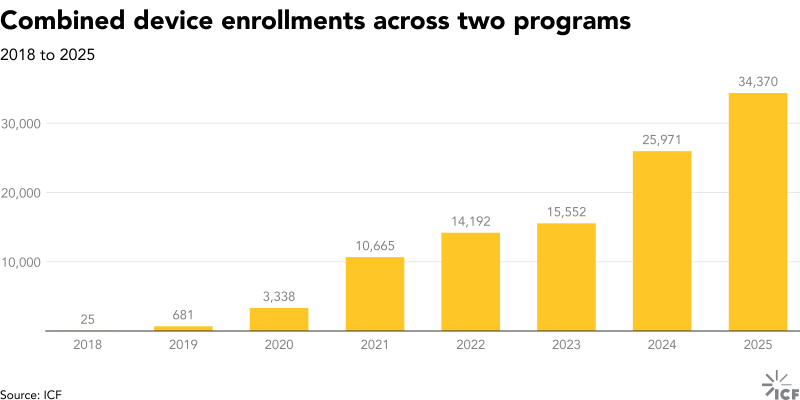
Two demand response programs for this utility launched in 2018 with minimal demand response awareness and virtually no enrolled devices. Over six years, our marketing strategy drove enrollment to more than 34,000 devices. When automation is combined with comprehensive marketing, utilities can exceed enrollment targets and maintain long-term momentum.
The foundation phase
With low program participation and automated enrollment reaching only early adopters, we developed a dual-track approach: paid search to capture high-intent prospects and social media to build broader awareness about demand response concepts.
Our creative strategy evolved significantly. Early messaging was information-heavy and focused on program mechanics. By 2021, we had shifted to benefit-driven messaging emphasizing what customers actually cared about: comfort, convenience, and savings.
The results validated this approach. Click-through rates increased 70% in one program, nearly doubling in another. Device enrollments grew from approximately 700 to more than 10,000 across both utilities. These early investments in awareness and education set the stage for later growth.
The acceleration phase
Maintaining growth requires reaching beyond early adopters to less tech-savvy customers. We expanded into new channels—responsive display, neighborhood-focused campaigns, and out-of-home placements—while introducing retargeting to reengage high-intent prospects. Ramping up cross-promotional efforts across marketplace platforms, Quick Home Energy Check-up (QHEC) contractor partnerships, and seasonal pushes allowed us to align messaging with summer and winter demand peaks.
We also refined our creative approach to emphasize benefits-focused storytelling, with simplified calls-to-action and visuals featuring homeowners in relatable settings.
The expanded channels and refined messaging drove significant growth. Click-through rates for one program reached 12.35%—nearly double the 2021 rate—while the other program saw increases by 35%. Enrollments nearly doubled from 2022 to 2024, and paid social impressions exceeded one million annually.
Complete orchestration phase
By 2025, we had evolved the programs into fully integrated campaigns across all available channels: connected TV, online video, high-impact display, expanded out-of-home placements, and Performance Max paid search optimization.
We carefully sequenced email communications throughout the customer journey—pre-season outreach to prepare customers, during-event notifications to maintain transparency, and post-event follow-up to reinforce value and encourage continued participation.
The results speak to sustained investment. One program achieved 134% of its participation goal with 27,650 devices enrolled, while the other reached 119% of its goal with 6,720 devices. Combined, these programs enrolled more than 34,000 devices.
These results required strategic marketing investment over six years, continuous creative optimization, and constant refinement of the customer journey.
Beyond marketing: Supporting success factors
Marketing drives enrollment, but it doesn’t work in isolation. Three supporting elements determine whether programs can keep participation up over time.
1. Data-driven targeting ensures that marketing investments deliver maximum impact. Geographic focus on capacity-constrained areas maximizes grid benefit, while behavioral and demographic segmentation identifies customers most likely to enroll and remain engaged. ICF’s Sightline platform supports this approach by prioritizing prospects based on propensity modeling and energy usage patterns, helping optimize marketing spend and improve engagement rates.

2. Customer experience and retention matter more than initial enrollment. Pre-event communication reduces surprise, during-event notifications maintain transparency, and post-event follow-up demonstrates impact. Programs must also respond quickly to customer questions and deliver seamless experiences through automated bill credits and responsive support. SMECO’s optimized dispatch approach, for instance, reduced opt-outs by balancing grid needs with customer comfort.
3. Contractor and trade ally engagement influences both enrollment and long-term success. HVAC contractors shape customer decisions during equipment purchases and installations. Proper training helps contractors explain how demand response works and reduces complaints, turning them into program advocates who educate customers during service calls.
Key takeaways
Automated enrollment by itself is necessary but insufficient for scalable demand response. Strategic marketing combined with automation delivers measurable, sustained enrollment growth by educating customers, building awareness, and driving device adoption beyond early adopters. As utilities face growing pressure to manage peak demand, marketing isn’t an optional add-on—it’s essential infrastructure.