U.S. natural gas outlook through 2030


Natural gas features prominently in today’s energy conversation—driven by a federal push for energy dominance, shifting geopolitics and trade dynamics, surging demand across the electricity sector, and a heightened focus on system reliability.
The U.S. natural gas market is experiencing rapidly rising demand due to increased liquefied natural gas (LNG) exports and accelerating electricity consumption, while infrastructure development has struggled to keep pace. Although the U.S. has abundant, low-cost natural gas resources, regional bottlenecks, permitting constraints, and evolving producer behavior are reshaping market fundamentals. The result is a tighter system characterized by upward price pressure, wider seasonal and regional volatility, and increased risks to affordability and reliability if infrastructure expansion lags demand growth.
A new report from ICF highlights where demand is growing fastest, why supply is increasingly constrained by deliverability rather than geology, and how timely pipeline and storage investments can stabilize prices and support system resilience through the end of the decade.
25%
projected rise in U.S. gas demand by 2030 relative to 2024
24%
projected growth in U.S. gas production by 2030 relative to 2024*
28 Bcf/d
projected pipeline takeaway capacity (2025-2030) needed to meet demand
$0.35 / MMBtu
price increase of average Henry Hub natural gas price compared to the previous six-year average (2019-2024)
*U.S. demand is met primarily through U.S. production but also imports from Canada.
Demand growth is accelerating—and highly concentrated
U.S. natural gas demand is projected to increase 25% by 2030 relative to 2024, reaching approximately 138 Bcf/d. Nearly 60% of this growth comes from LNG exports, reflecting the rapid build out of Gulf Coast liquefaction capacity and strong international demand for U.S. gas. Another 22% of incremental demand is driven by the power sector, as electricity consumption rebounds after a decade of stagnation and large, reliability sensitive loads—such as data centers—expand across several regions.
Total U.S. natural gas demand in the contiguous U.S.
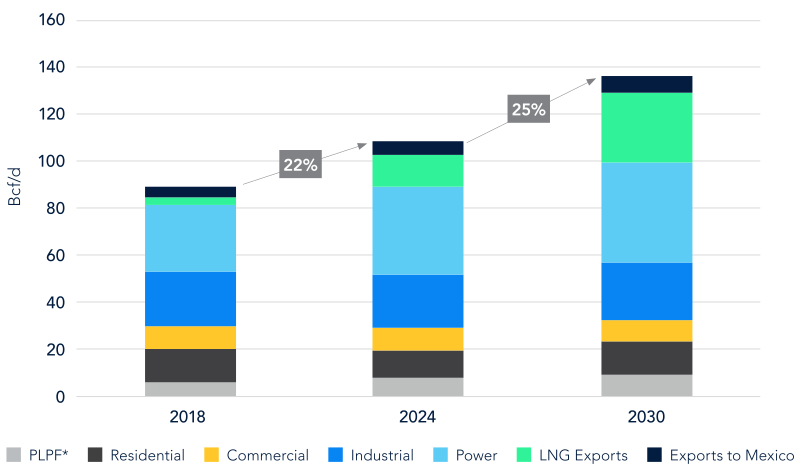
Source: ICF Q4 2025 North American Natural Gas Base Case; Energy Information Administration (EIA) Note: *PLPF refers to pipeline, lease and plant fuel
While national demand growth is substantial, it is also uneven. LNG demand is heavily concentrated along the Gulf Coast, while power sector growth is pronounced in some regions already facing pipeline constraints. This geographic mismatch between supply, infrastructure, and load growth elevates the importance of targeted investments to move gas from low-cost producing basins to demand centers efficiently.
Supply is abundant—but increasingly constrained by infrastructure
ICF projects U.S. natural gas production to grow 24% (about 25 Bcf/d) by 2030 relative to 2024. Growth is led by the Permian Basin, followed by Haynesville and Appalachia, with associated gas from oil production remaining the lowest cost source of incremental supply. Dry gas resources in Appalachia and Haynesville continue to offer competitive economics, but their ability to serve growing markets depends on takeaway capacity.
U.S. natural gas production by major shale resources (Bcf/d)
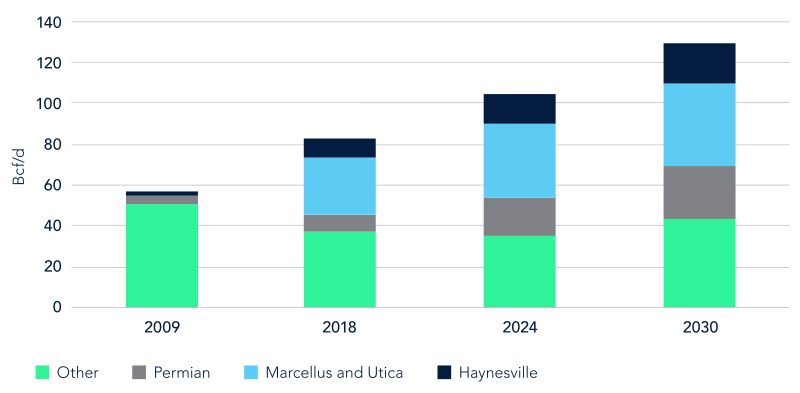
Source: ICF Q4 2025 North American Natural Gas Base Case
Infrastructure—not resource availability—is the binding constraint. Over the past decade, interstate pipeline development, particularly out of the Appalachian Basin, has faced permitting challenges, opposition, and rising costs. As a result, some of the nation’s cheapest gas struggles to reach high demand regions, amplifying regional basis volatility and limiting supply responsiveness during peak periods. At the same time, producers are prioritizing capital discipline and shareholder returns, reducing the elasticity of supply even when prices temporarily rise.
Infrastructure needs are large—and uncertain
To support rising demand, ICF projects that approximately 62 Bcf/d of new pipeline capacity will enter service between 2026 and 2030, including new takeaway pipelines, brownfield expansions, and middle mile infrastructure connecting major systems to LNG terminals, citygates, and large industrial loads. However, this outlook already reflects development risk: projected service capacity is roughly 11 Bcf/d lower than the volume of currently proposed projects, underscoring uncertainty around execution.
Announced/Under construction pipeline capacity for 2026-2030 (Bcf/d)
| Project status | Pipeline project capacity |
| Brownfield or under construction | 43.5 |
| Greenfield low-risk states | 11 |
| High-risk states | 4 |
| Early-stage proposed projects | 14.5 |
| Total | 73 |
Note: Low-risk states are those with no history of denying water and air permits such as Texas and Louisiana. High-risk states are those with a history of denying water and air permits.
The table shows pipeline capacity (takeaway and middle-mile) of all projects that are proposed and under construction. Not all these projects are included in the ICF Q4 2025 Base Case.
Permitting remains a significant barrier to timely infrastructure delivery. While intrastate projects in Texas and Louisiana generally advance more quickly, interstate projects—especially in the Northeast—continue to face delays and litigation. Recent federal actions have begun to streamline permitting, but regulatory and legal risks remain significant enough to shape which projects ultimately proceed.
Infrastructure as a stabilizing force
Historically, timely infrastructure development enabled the U.S. to absorb rapid demand growth without sustained price escalation. During the early shale revolution, new pipelines connected emerging supply basins to demand centers, keeping prices low even as consumption surged. That stabilizing mechanism is now weaker. With fewer balancing options in the power sector (shrinking coal-gas switching capability) and tighter infrastructure, the system is more sensitive to supply disruptions, weather, LNG utilization, and regional constraints.
Looking ahead, pipelines and storage are the most effective tools for moderating volatility. Expanding deliverability from low-cost basins, enhancing middle-mile connectivity, and adding storage capacity can reduce basis blowouts, improve reliability, and protect consumers from sharp price swings during peak demand periods.
Prices are rising modestly—but volatility is increasing
ICF forecasts average Henry Hub prices to reach about $4.30/MMBtu in nominal terms ($3.97/MMBtu real) by 2030, assuming normal weather conditions. This represents a real increase of roughly $0.35/MMBtu compared with the 2019–2024 average, signaling tighter market fundamentals than those that prevailed during the shale-driven surplus of the 2010s.
Henry Hub (Real 2024$/MMBtu) and U.S. dry natural gas production (Bcf/d)
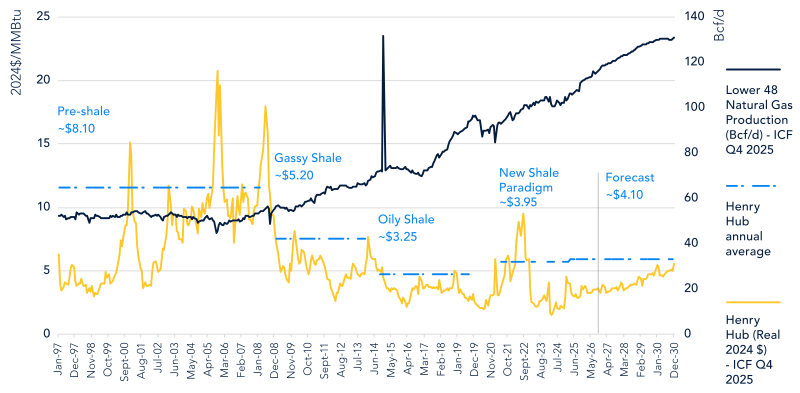
Source: Energy Information Administration (EIA) for historical price and production data. ICF Natural Gas Q4 2025 Base Case Outlook for forecasted production and prices.
Several structural factors underpin this outlook:
- Limited takeaway capacity from low-cost basins, especially in Appalachia.
- Reduced coal-to-gas switching as coal retirements erode demand flexibility.
- Producer capital discipline, which raises the price threshold for new supply.
Beyond higher averages, seasonal and regional price volatility is expected to intensify. Winter price spikes are likely as LNG exports and gas-fired generation compete for supply, while shoulder seasons may see weaker demand as renewables capture incremental generation. Storage and pipeline investments therefore play a critical role in smoothing price swings and supporting reliability.
What this means for decisionmakers
Through 2030, the U.S. natural gas market will be shaped less by geology and more by policy, permitting, and investment decisions. For utilities, developers, investors, and policymakers, the implications are clear:
- Demand growth is real and near-term, led by LNG and electricity load growth, even as renewables account for a significant portion of new capacity additions.
- Infrastructure timing matters—delays translate directly into higher prices and volatility.
- Price pressure is rising, even with abundant domestic resources.
- Strategic infrastructure investment is essential to sustaining affordability, reliability, and U.S. competitiveness in global energy markets.
Understanding where constraints are most acute—and which projects can realistically advance—will be critical to navigating this next phase of U.S. natural gas market evolution.
Download the full paper to explore our comprehensive outlook for U.S. natural gas demand, supply, infrastructure, and prices through 2030.