New York City’s building performance accelerator
We provided New York City with technical assistance to engage with building managers and owners, showcasing data-driven pathways for them to undertake affordable projects to reduce carbon on their properties
Challenge
The vast majority of New York City’s overall emissions—more than six times that of the transportation sector—stem from inefficient buildings of all sizes and use types. To reach its goal of citywide carbon neutrality by 2050, New York City needs its building sector partners to reduce their carbon usage and eventually electrify their properties.
Earlier policies and pilot projects made meaningful progress toward eliminating or reducing buildings’ overall emissions. The phase-out of just one type of fuel oil alone in over 6,000 buildings between 2011 and 2015 helped bring about the city’s best air quality in over half a century, subsequently preventing hundreds of early deaths and thousands of hospitalizations. And nearly 3,000 buildings underwent major projects through the NYC Retrofit Accelerator between 2015 and 2020.
However, additional momentum was needed. New York City enacted Local Law 97 (LL97), the law requiring buildings over 25,000 square feet to fall below established carbon emission thresholds or face fines of $268 per ton of carbon emitted over the limit. That could add up to millions for some of the worse emitters, with roughly 75% of covered buildings facing penalties starting in 2030 if improvements weren’t made. New York City needed to light a clear path forward for its building partners to comply with local efficiency policies and avoid penalties for noncompliance.

Solution
To incentivize building administrators to launch efficiency and solar projects, we helped New York City develop NYC Accelerator—a hands-on program that guides building owners and managers through the full process of improving their properties. ICF served as the full-service implementation partner behind the program, managing everything from data-driven field outreach and technical assistance to marketing, contractor vetting, and training.
At the core of the program was a team of field account managers who worked directly with building decision makers across every borough, from large corporate management teams to small co-op and condo boards. Using data-driven targeting, we identified which buildings faced the greatest compliance risk under LL97 and prioritized outreach accordingly. From there, our team provided individualized guidance, helping building owners understand their options, access financing, select vetted contractors, and navigate the numerous steps required to complete a project.
To build broad awareness of the program and drive participation, we ran a sustained multimedia marketing effort across paid, earned, and owned channels. Over the course of the program, we shifted from 100% outbound outreach to 100% inbound engagement, with building owners actively seeking out assistance on their own. A centerpiece of that effort was the program website, which won two Gold Hermes Creative Awards and featured a Building Energy Snapshot tool allowing any property owner to look up their building’s compliance status and savings opportunities.
“Buildings are the majority of New York City’s carbon emissions. NYC Accelerator is so important to us. It allows us to target buildings with a heavy lift ahead, and engage them early to meet carbon efficiency targets.”
Results
From early 2021 to November 2025, our team engaged with the administrators of approximately 33,000 buildings in every borough of New York City, representing over 50% of all LL97 covered buildings, over 1.8 billion square feet of real estate, and 1.3 million units.
Over 20,000 of those buildings took action:
- 10,000 buildings completed retrofits including HVAC improvements, envelope upgrades, electrification, and solar installations, nearly doubling the program’s original portfolio goal of 5,850.
- 10,000 additional buildings completed planning for LL97 compliance, electrification, or solar.
Completed retrofit projects are projected to reduce emissions by approximately 27,000 metric tons of carbon dioxide and save nearly $11 million annually. Broader pipeline of projects not yet completed is projected to deliver an additional 160,000 metric tons of carbon dioxide reductions and $46.5 million in savings.
33K+
buildings in every New York City borough engaged
2M+
website visits
2K+
building decision makers and service providers trained
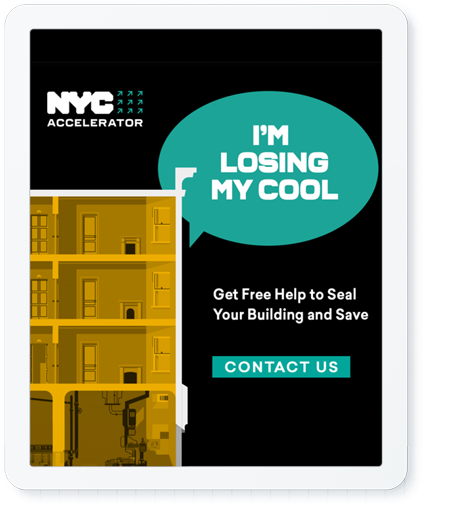
Along the way, the program has built new paths in the New York City’s energy economy. We trained over 2,000 building decision makers and service providers and placed interns into local energy jobs. Our team also vetted and enrolled more than 350 local contractors into a supporting service provider program. All program-generated leads and activated buildings were referred to program providers, supporting and growing the local economy. These actions don’t just benefit the city’s climate goals—they strengthen communal knowledge and ensure a skilled, local talent network.
Related client stories