FEMA BRIC is back: What the restart means for resilience funding
After an extended pause that created uncertainty for state, local, tribal, and territorial governments, FEMA’s Building Resilient Infrastructure and Communities (BRIC) grant program has resumed operations—reshaping the competitive landscape for resilience funding at a time when demand for mitigation investments continues to grow.
On March 6, 2026, a federal court enforcement order directed FEMA to take specific, timely actions to advance the program after the pause that left many important mitigation projects in limbo. Since that ruling, FEMA has taken required actions to restart the program, reengage with states and territories, and release a combined Fiscal Year (FY) 2024–2025 Notice of Funding Opportunity (NOFO).
What is clear is that FEMA and the federal administration continue to view mitigation as a worthwhile investment. The NOFO retains the program’s core priorities, emphasizing cost-effective mitigation projects in jurisdictions with strong building code adoption and enforcement, while accounting for future conditions to ensure risk reduction investments deliver sustained benefits to communities.
Brief program history
BRIC was established by Congress in 2018 to provide consistent, nationwide funding for hazard mitigation projects that reduce risk before disasters occur. The program launched its first funding cycle in FY 2020 and operated continuously through FY 2023, becoming the country’s primary competitive pre-disaster mitigation grant program.
BRIC was paused during the FY 2024 funding cycle, and FEMA has since been instructed to reissue the FY 2024 NOFO and make FY 2025 and FY 2026 funding available, formally restarting the program.
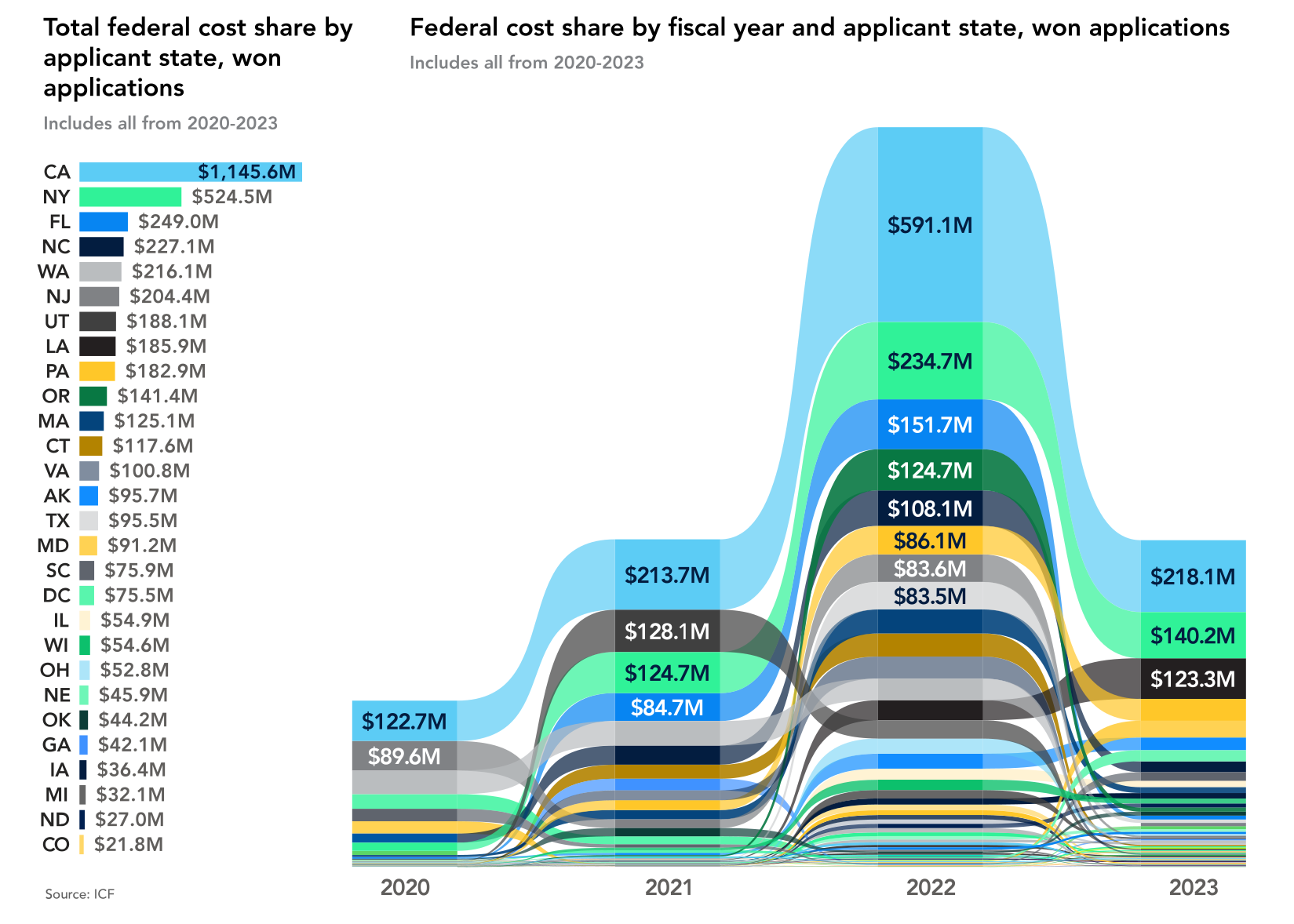
Between FY 2020 and FY 2023, FEMA obligated approximately $1 billion in federal funding through the BRIC program, out of roughly $4.6 billion in selected awards during that period. Excitingly, more of those awards are expected to transition to obligations this year. Figure 1 provides a visual of the magnitude of federal cost share selected for further review, by state applicant, over the last four fiscal years.
Figure 1: Federal cost share by applicant for BRIC FY2020 to FY2023
What to know about the FY 2024-2025 NOFO
Several updates in the FY 2024–2025 NOFO have important implications for how projects are prioritized, evaluated, and funded.
On March 25, 2026, FEMA released a joint FY 2024–2025 BRIC NOFO, which outlines funding availability, eligibility, priorities, and evaluation criteria, while also reflecting various programmatic adjustments that will shape how applications are reviewed and funded moving forward. Figure 2 demonstrates the fiscal breakdown of the FY 2024 -2025 BRIC NOFO.
Figure 2: Funding availability overview
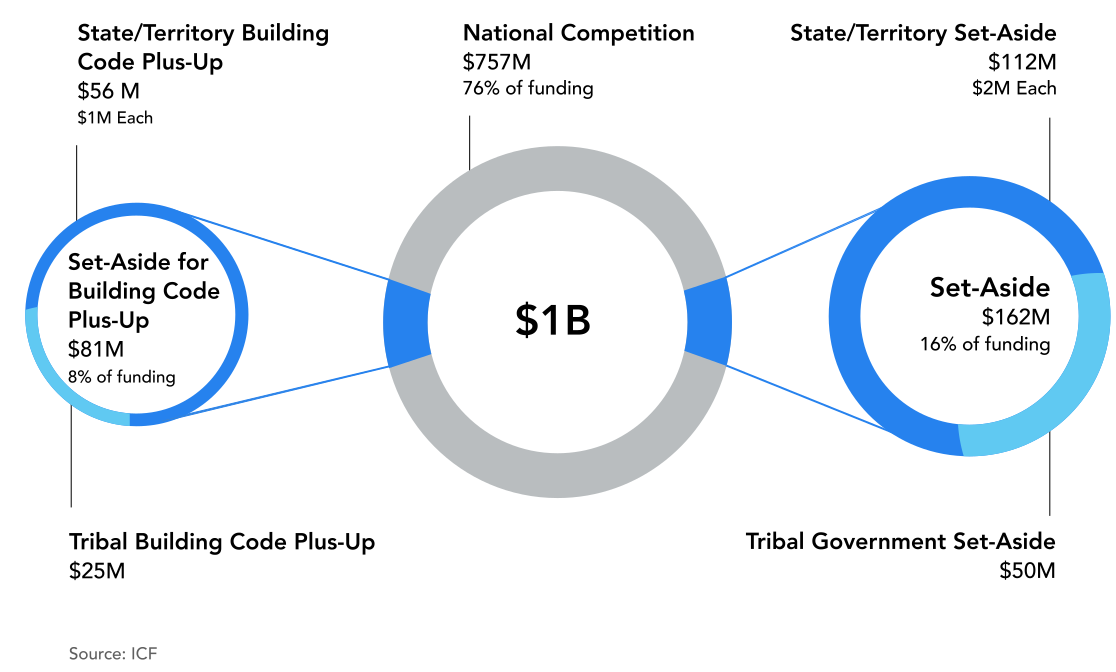
For this BRIC funding cycle, a total of $1 billion in funding is available, with $757 million through the national competition, $81 million set-aside for building code plus-up, and $162 million for state/territory and tribal government set-aside. Though each applicant (state/territory/tribal government) can submit an unlimited number of hazard mitigation project subapplications up to $20 million each, applicants cannot receive more than 15% of the total pot of funding, or $150 million. This will likely make the state subapplication review process for high-capacity states more competitive. That said, this can also support the distribution of funds across a broader range of geographies.
Applications are due in the FEMA Grant Outcomes (FEMA GO) portal by July 23, 2026. Subapplicants should coordinate with their state hazard mitigation office as state deadlines will occur before July 23.
Review of the FEMA GO subapplication form indicates that required content remains largely consistent with prior years. However, FEMA has introduced several programmatic changes, including:
- A stronger emphasis on projects that directly improve infrastructure resilience, prioritizing investments that demonstrably reduce risk to critical structures that impact the economy, such as transportation, utilities, water, wastewater, communications, and public buildings.
- Updated and streamlined national competition evaluation criteria, including added points for first‑time applicants or subapplicants that have not been selected in prior BRIC cycles, and a sliding scale that awards points based on infrastructure project construction readiness (percent design). The NOFO no longer distinguishes between technical and qualitative evaluation criteria, simplifying scoring and resulting in a faster FEMA review process.
- New funding caps, including a limit on the total federal share (15%) any given applicant may receive and a maximum federal award amount per individual project ($20 million).
- Prioritization of shovel-ready projects that have a high return on investment. Projects in the conceptual design phase (at least 30% design) are eligible but projects with detailed drawings and specifications (at least 90% design) will score much higher.
- Targeted use of capability- and capacity-building (C&CB) activities to develop FEMA compliant infrastructure projects and advance construction readiness, or to strengthen the adoption and enforcement of hazard-resistant building codes. Activities that are not directly tied to a specific infrastructure project, such as standalone planning, general training, or exploratory scoping, are no longer eligible under C&CB.
- Hazard Mitigation Plans are no longer eligible for funding under BRIC, signaling a potential shift toward state, territorial, and tribal nation responsibility for funding mitigation planning.
- Ten percent of project funding may be used for outreach activities, provided those efforts are clearly tied to advancing infrastructure resilience outcomes rather than general engagement.
- Special cost‑share flexibility for insular areas, such as the U.S. Virgin Islands, Guam, and American Samoa, where FEMA will automatically waive the non‑federal cost share for awards with a total match under $200,000 and may waive all or part of the cost share for larger awards upon request in the subapplication.
While the FEMA GO subapplication content and structure remains largely consistent with prior years, these changes have important implications for project sizing, prioritization, and competitiveness.
The following actions can help state and local governments position themselves competitively under the FY 2024–2025 BRIC NOFO.
Recommendations to maximize application competitiveness
While state, local, tribal, and territorial governments may have reservations about the program amid recent uncertainty, the court's ruling ensures BRIC will continue operating with funding available through at least FY 2026.
Given the combined NOFO, BRIC will likely be more competitive than in previous years. The record funding level will draw increased interest, while growing hazard risks and fiscal strain are pushing communities nationwide to prioritize mitigation investments. The new per-state funding cap will also pressure states to be more selective about which subapplications they advance to FEMA.
ICF recommends the following actions that state and local governments can take now to position themselves for success.
Recommendations for state agencies
1. Proactively deliver technical assistance to communities. Help locals identify strong infrastructure scoping and/or mitigation projects that are near shovel‑ready and capable of meeting benefit‑cost analysis requirements, with early outreach focused on small impoverished communities and those that have not previously submitted BRIC subapplications.
2. Re‑evaluate and refine state prioritization frameworks. Align prioritization processes with updated BRIC evaluation criteria, placing greater emphasis on traditional infrastructure projects, construction readiness, and clearly defined risk‑reduction outcomes and quantified return on investment.
3. Rapidly assess previously submitted subapplications. Given the compressed application timeline, provide targeted outreach and technical assistance to determine which projects remain viable under the new scoring criteria.
4. Advance all eligible subapplications to FEMA. The NOFO indicates that FEMA retains discretion on awards based on geographic distribution and alignment with administration, agency, and program priorities. Submitting all eligible subapplications will increase the likelihood of funding awards as FEMA makes final selection decisions through the national competition.
Recommendations for local jurisdictions
1. Engage with your state to understand the pre-application, review, and prioritization process. Work with your state’s emergency management agency to understand how pre-applications and subapplications will be evaluated, prioritized, and submitted, including how any previously submitted FY 2024 BRIC subapplications will be handled.
2. Prioritize shovel‑ready infrastructure projects. The updated evaluation criteria place a clear emphasis on projects that are 90–100% designed, allowing subapplicants to gain up to 30 points in the evaluation. Projects at 30% design or greater can still receive points and may remain viable candidates, particularly when paired with a clear path to advancing design and construction readiness.
3. Use project scoping to intentionally build a competitive pipeline. Leverage infrastructure and project scoping subapplications to advance FEMA-eligible infrastructure project design and build a competitive pipeline of shovel-ready projects for future Hazard Mitigation Assistance (HMA) grant cycles.
4. Align subapplication language directly with the FY 2024-2025 NOFO. Use terminology and framing from the NOFO throughout your scope of work narrative to clearly demonstrate project alignment with administration and FEMA priorities. Use NOFO-aligned terms such as ‘future conditions’ and ‘natural hazard risk reduction.’ Additionally, the new evaluation criteria do not clearly align with the FEMA GO subapplication template, so be sure to address these criteria throughout the subapplication and in your additional comments.
5. Right-size projects under the new funding caps and evaluation criteria. Given the $20 million per project cap, prioritize appropriately scoped projects that can be fully delivered within funding limits. For projects that are close to the $20 million cap, consider increasing local match to demonstrate commitment and reduce reliance on federal funds.
6. Clearly link risk‑reduction benefits to the project’s Benefit Cost Analysis (BCA) and throughout the subapplication narrative. Make the quantitative value of risk reduction explicit by clearly presenting the benefit cost ratio, number of people served, and losses avoided. Consistently reinforcing these metrics across the subapplication strengthens the risk‑reduction case and helps maximize points under FEMA’s evaluation criteria.
7. Closely track ongoing BRIC updates from FEMA and your state emergency management agency. Recognize that program guidance may continue to evolve even after subapplications are submitted. Attend FEMA‑ and state‑led BRIC NOFO webinars and monitor press releases and updates from professional associations such as the Association of State Floodplain Managers (ASFPM) and the National Hazard Mitigation Association (NHMA) to stay informed of changes that could affect project eligibility, evaluation, or implementation.
Navigating the application process
The application period opened on March 25, 2026. All applications must be submitted in FEMA GO by 3pm ET on July 23, 2026, though states will likely develop earlier deadlines. Interested subapplicants should consult with their State, Tribal, or Territorial agency and monitor their websites for additional details and deadlines for pre-applications and sub-applications. States often have their own deadlines for pre-applications (or Letters of Interest, Notices of Intent, etc.) and subapplications that enable them to conduct a thorough review, request additional information, and ultimately approve or deny submission to FEMA. We encourage you to reach out to your State Hazard Mitigation Office or other State, Tribal, or Territorial agency for assistance.
This article will be updated as FEMA releases additional information.